When you come across the term expository text, you might wonder what it actually means and how it differs from other types of writing. In simple words, expository text is writing that explains, informs, or teaches the reader about a particular topic.
Its main purpose is to provide clear facts and useful information rather than tell a fictional story or persuade someone to agree with an opinion.
You can find expository writing in many places, including textbooks, news articles, essays, instructions, websites, and educational materials.
Quick answer:
Expository text is nonfiction writing that explains or informs the reader about a topic using facts, clear structure, and objective language. Its main goal is to help the reader understand something, not to entertain or persuade.
What Does “Expository Text Meaning” Mean?
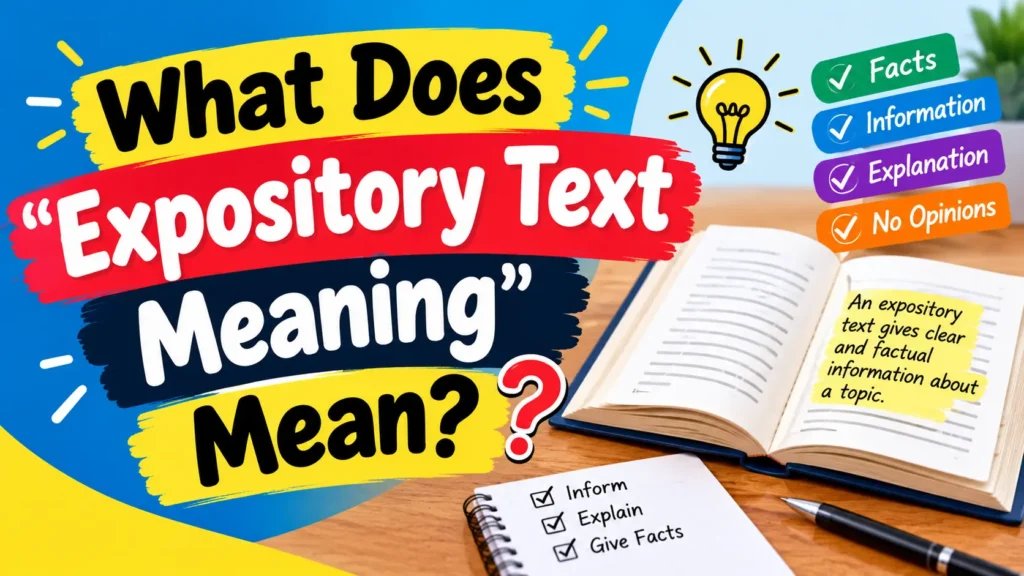
The simple definition of expository text meaning is this: it is writing that exposes or sets forth information so the reader learns something.
In plain English, think of it as the “teacher” of writing styles. The writer assumes you may not know much about the subject and carefully explains it step by step. The language stays neutral. There is little or no “I feel” or “you should.” Instead you find facts, definitions, examples, and logical order.
Literally, the word “expository” comes from “expose,” which means to show or make clear. The most common meaning today is any text whose main purpose is to inform or explain. Textbooks, scientific reports, instruction manuals, and many online articles are classic examples.
This style belongs to the four main types of writing (or rhetorical modes): narrative (tells a story), descriptive (paints a picture), persuasive (tries to convince), and expository (explains). Expository writing sits firmly in the “explain” category.
Meaning in Different Contexts
The core expository text meaning stays the same—inform and explain—but the way it appears changes with the setting.
Everyday Conversation
People rarely say “expository text” out loud, yet they use the idea all the time. When a friend calmly explains how a new phone app works or how to change a tire, they are speaking in an expository way: clear facts, step-by-step order, no drama.
Text Messages
Short messages can still be expository. A parent might text: “Dinner is at 6. Please set the table and wash the vegetables first.” The message gives information and clear steps without emotion or storytelling.
Social Media
On platforms where people share knowledge, many posts take an expository form. A short thread that lists the steps to start a vegetable garden or explains why bees matter is pure expository writing. The goal is understanding, not likes through drama.
Group chats often contain practical expository messages: meeting times, directions, or shared instructions. “Meet at the park gate at 4. Bring water and a ball.” Clear, factual, helpful.
Snapchat and Instagram
These platforms favor visuals, yet captions or story text can be expository. A cooking creator might write: “This recipe needs three eggs, 200 grams of flour, and 10 minutes of mixing. Bake at 180 degrees for 25 minutes.” The caption informs rather than persuades or entertains.
TikTok
Educational TikTok videos often pair spoken words with on-screen text that is purely expository. A video explaining how volcanoes form or how to tie a certain knot uses short, factual sentences.
Gaming
Game guides and wiki pages are classic expository text. They explain character abilities, level strategies, or how to unlock items. Players read them to gain knowledge, not to be entertained by a story.
Professional Communication
Emails, reports, memos, and manuals almost always use an expository approach. A project update that lists completed tasks, next steps, and deadlines is expository writing at work.
Internet Slang and Online Learning
Even in informal online spaces, “expository text” is a standard school term. Students search for its meaning when teachers assign essays or reading passages. The term itself is formal, but the writing style appears everywhere information is shared.
In every context the purpose remains the same: give the reader clear, useful knowledge.
Examples of “Expository Text”
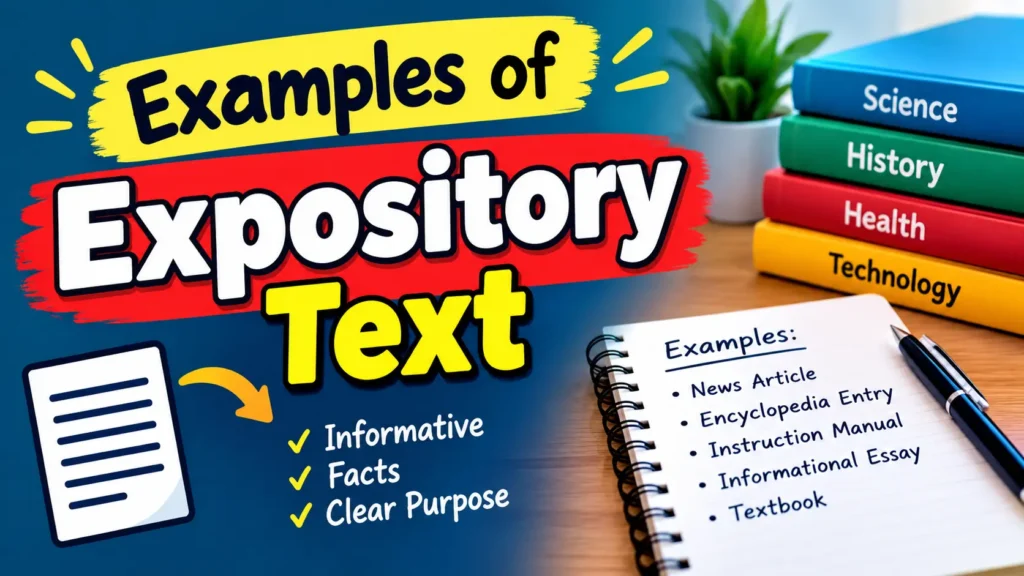
Here are five real-life examples that show expository text meaning in action.
- Sentence: “The water cycle has four main stages: evaporation, condensation, precipitation, and collection.” Meaning: It explains a natural process with clear steps and no opinion. Situation: A science textbook page for middle-school students.
- Sentence: “To reset your password, open the login page, click ‘Forgot Password,’ enter your email, and follow the link sent to your inbox.” Meaning: Step-by-step instructions that help the reader complete a task. Situation: A company help-center article or user manual.
- Sentence: “Honeybees pollinate about one-third of the food crops grown in the United States each year.” Meaning: A factual statement that informs the reader about an important role bees play. Situation: A nature magazine article or educational website.
- Sentence: “Photosynthesis is the process by which green plants use sunlight to make food from carbon dioxide and water.” Meaning: A clear definition followed by a simple explanation of a scientific concept. Situation: An encyclopedia entry or classroom handout.
- Sentence: “First, wash the rice. Next, add two cups of water for every cup of rice. Then bring the water to a boil, reduce the heat, and cover the pot for 18 minutes.” Meaning: Sequential instructions that teach a practical skill. Situation: A recipe card or cooking blog.
Each example focuses on facts and clarity. None tries to make you laugh, cry, or change your mind about an issue.
When Do People Use “Expository Text”?
People use expository text whenever the main goal is to share knowledge.
Common situations include school assignments, workplace reports, product instructions, news explanations, and how-to content online. Teachers ask students to write it so they learn to organize ideas logically. Scientists and journalists use it to present research or events without personal bias. Everyday people use it when they write clear directions or explain a process to a friend.
Who uses it? Students, teachers, professionals, technical writers, content creators, and anyone who needs to pass on information accurately.
Why do people choose this style? Because it is efficient. Readers can find the information quickly, understand it easily, and trust that the writer is not pushing an agenda.
Appropriate situations are any time the reader needs facts more than feelings or opinions. Inappropriate situations include moments when the goal is pure entertainment (a short story) or strong persuasion (a political speech). Mixing styles is common, but pure expository writing stays neutral and informative.
Different Meanings of “Expository Text”
The main expository text meaning is informational writing. However, a few related uses appear in different fields.
In school and everyday writing
Definition: Nonfiction text that explains or informs.
Context: Classrooms, textbooks, online articles.
Example: A student essay that explains the causes of the seasons.
In literature and storytelling
Definition: Background information given to the reader so the story makes sense (sometimes called narrative exposition).
Context: Novels, plays, films.
Example: The opening paragraphs that describe the setting and introduce the main character’s past.
In music
Definition: The first section of a piece in sonata form that presents the main themes.
Context: Classical music analysis.
Example: The opening of a Beethoven sonata where the main melodies are introduced.
The school and writing meaning is by far the most common when people search for “expository text meaning.”
Origin of “Expository Text”
The word “expository” entered English in the early 1600s. It comes from the Latin exponere, which means “to set forth” or “to explain.” The related verb “expound” has been used since the 14th century to mean explaining something carefully, especially religious texts.
The idea of writing that explains rather than tells stories is much older. Ancient teachers and philosophers used clear, factual styles. In modern education, the four modes of discourse—narration, description, exposition, and argument—became standard in the 19th and 20th centuries. Today the term is firmly linked to school writing and informational content.
There is no single dramatic invention date for “expository text.” The concept grew naturally as people needed reliable ways to pass on knowledge.
Similar Words and Alternatives
Several words and phrases sit close to expository text meaning.
- Informational text – almost the same; focuses on facts and knowledge.
- Explanatory writing – emphasizes making ideas clear.
- Nonfiction – broader category that includes expository pieces.
- How-to writing or instructional text – a specific type of expository writing that teaches steps.
- Descriptive writing – focuses on sensory details rather than pure explanation.
- Persuasive writing – tries to convince rather than simply inform.
The key difference is purpose. Expository and informational writing aim to teach. Descriptive writing aims to create a picture. Persuasive writing aims to change minds.
Common Mistakes
Many people confuse expository text with other styles.
One common error is adding strong personal opinions. A true expository piece stays neutral. Saying “This is the best way to cook rice” turns the writing persuasive.
Another mistake is turning the text into a story. Adding “Once upon a time a farmer planted seeds…” shifts the piece into narrative.
Some writers make the language too complicated. Expository text works best when it is simple and organized.
Tips to avoid confusion:
- Ask yourself, “Am I mainly explaining or mainly arguing/entertaining?”
- Use facts, examples, and clear structure.
- Keep the tone calm and helpful.
- Check that a reader who knows nothing about the topic can still follow.
Frequently Asked Questions
What is the main purpose of expository text?
The main purpose is to inform or explain a topic so the reader understands it better.
How is expository text different from narrative text?
Narrative text tells a story with characters and events. Expository text gives facts and explanations without a storyline.
What are the common structures of expository text?
Popular structures include description, sequence (steps), compare and contrast, cause and effect, and problem and solution.
Can expository text include opinions?
Strong personal opinions usually move the writing into the persuasive category. Good expository writing stays mostly factual.
Is a recipe an example of expository text?
Yes. Recipes explain a process with clear steps and ingredients, which fits the definition perfectly.
Why do schools teach expository writing?
Schools teach it because students need the skill to write reports, explain ideas clearly, and understand informational texts throughout life.
How can I improve my own expository writing?
Start with a clear main idea, organize information logically, use simple language, support points with facts or examples, and end with a short summary.
Conclusion
Expository text meaning centers on clear, factual writing that explains or informs. It is the style you meet in textbooks, manuals, news explainers, and many online articles. The writer’s job is to make a topic understandable without storytelling drama or strong persuasion.
You now know the simple definition, how the meaning appears in everyday messages and professional settings, real examples, when people use it, related terms, common mistakes, and answers to frequent questions.

Ethan Carter is a passionate writer who creates simple, informative, and engaging content. He focuses on language, grammar, word meanings, and everyday expressions to help readers understand things clearly.