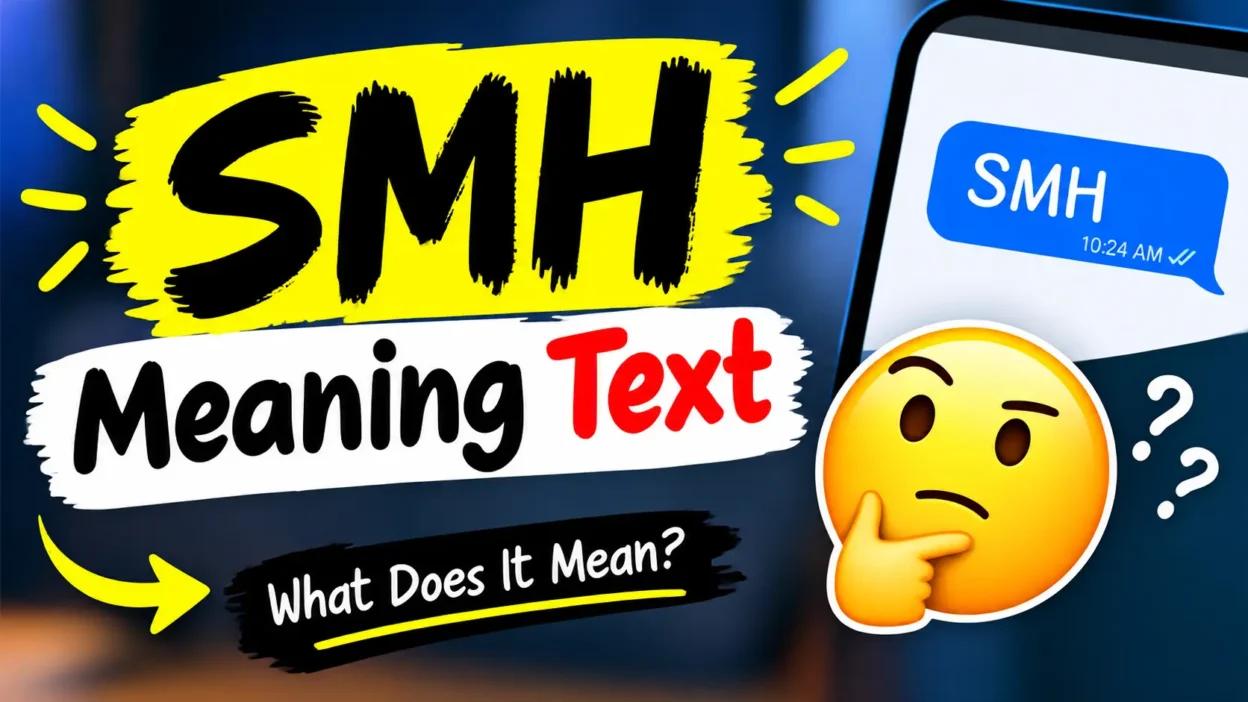
If you have ever received a text that simply says “SMH”, you might have paused for a second and wondered what the person actually meant. In texting, SMH meaning text is usually “shaking my head.”
People use it to show disappointment, disbelief, annoyance, embarrassment, or frustration about something someone said or did.
For example, if your friend forgets their keys for the third time, you might reply, “SMH, how did you forget them again?”
Quick Answer:
SMH means “shaking my head.” People use it in text messages and online posts to show disappointment, disbelief, frustration, or mild disapproval, almost like they are shaking their head from side to side without needing to write a long explanation.
What Does “smh meaning text” Mean?
In the simplest words, the smh meaning text is “shaking my head.”
It is a short way to copy the physical action of moving your head slowly left and right. In real life that gesture often means “I cannot believe this,” “that was a bad idea,” or “I’m disappointed.” Online and in messages, the letters SMH (or smh) do the same job.
The literal meaning is the gesture itself. The most common everyday meaning is a mix of mild judgment and quiet frustration. It is not usually angry. It is more like a soft sigh mixed with an eye-roll. You use it when something feels silly, poorly thought out, or just plain unfortunate, and you want the other person to notice your reaction without writing a full paragraph.
Because texting removes tone of voice and body language, abbreviations like this help fill the gap. SMH lets the reader picture the head shake and understand the feeling behind the words.
Meaning in Different Contexts
The core idea stays the same, but the exact flavor of SMH can change a little depending on where and how people use it.
Everyday Conversation
In normal spoken talk, people rarely say the letters out loud. They just shake their heads. When the letters appear in written notes or group chats, they still carry the same everyday feeling of “come on” or “really?”
Text Messages
This is where most people first meet the term. A friend might send a story about locking their keys in the car for the third time and end with “smh.” The letters tell you they know it was a silly mistake and they feel a bit silly themselves. In private texts the tone is usually light and friendly.
Social Media
On public platforms SMH often appears under posts that feel ridiculous or disappointing. Someone might share a news story about a small problem that got blown out of proportion and simply comment “smh.” Here the letters act as a quick public reaction that many readers instantly understand.
In WhatsApp groups and private chats the use is almost the same as regular texting. People drop SMH after a long story or a photo that shows a small fail. Because WhatsApp feels more personal than public social media, the tone stays softer and more conversational.
Snapchat
On Snapchat the letters often appear in the chat that follows a Story or a Snap. Someone posts a photo of a burnt dinner and a friend replies “smh.” The short reply matches the fast, visual style of the app.
Under Instagram posts and in DMs, SMH shows up as a comment or reaction. It is common under reels that show funny fails or under posts that share questionable fashion choices. The meaning stays “I am shaking my head at this.”
TikTok
TikTok comments and video captions love short reactions. SMH appears under clips of people making obvious mistakes or sharing bad decisions. Sometimes creators even put “smh” in the on-screen text to match the mood of the video.
Gaming
In game chats and Discord servers players use SMH when a teammate makes a clear error or when the game itself feels unfair. The letters express “that play was rough” or “I cannot believe the matchmaking did that” without stopping the flow of the game.
Professional Communication
In most work emails or formal chats SMH is best avoided. The casual, slightly judgmental tone does not fit office settings. People stick to clearer language so there is no chance of misunderstanding.
Internet Slang
As pure internet slang, SMH sits beside other short reactions such as LOL, OMG, and facepalm. It is one of the classic ways to show a nonverbal reaction in pure text.
Examples of “smh meaning text”
Here are five clear, real-life style examples so you can see exactly how the letters work.
- Sentence: “I left my phone on the bus again smh.” Meaning: The person is disappointed in themselves for repeating the same mistake. Situation: A private text to a close friend after a small personal fail.
- Sentence: “They cancelled the concert two hours before it started. Smh.” Meaning: Mild frustration and disbelief at the poor planning. Situation: A social media post or group chat about disappointing news.
- Sentence: “He still thinks pineapple belongs on pizza smh.” Meaning: Playful disagreement mixed with light judgment. Situation: A casual comment under a food-related Instagram post or TikTok.
- Sentence: “We lost the match because someone forgot the ultimate ability. SMH.” Meaning: Team frustration at an obvious gaming mistake. Situation: A Discord or in-game chat right after a loss.
- Sentence: “My neighbor parks across two spots every single morning smh.” Meaning: Ongoing mild annoyance at a repeated inconsiderate action. Situation: A text or local community group chat.
In every case the letters replace a longer sentence such as “I am shaking my head at this” while still keeping the emotional tone clear.
When Do People Use “smh meaning text”?
People reach for SMH in situations that feel mildly ridiculous, disappointing, or hard to believe. Common triggers include:
- Small personal mistakes (forgetting keys, missing a bus)
- Other people’s questionable choices (bad fashion, odd opinions)
- Unexpected bad news (cancellations, delays)
- Funny fails shared online
- Gaming errors or unfair moments
Who uses it? Almost everyone who texts or uses social media, teens, young adults, and many older users who have picked up the slang. It is especially popular among people who want a quick reaction that still feels natural.
Why do people use it? Because typing three letters is faster than explaining the feeling, and the gesture is almost universal. It also softens the judgment.
Appropriate situations are casual chats, friendly group messages, and social media comments where everyone understands the slang. Inappropriate situations include formal work emails, serious conversations about real problems, or any message where the other person might take the mild judgment too personally. When the topic is heavy, clearer words are kinder.
Different Meanings of “smh meaning text”
While “shaking my head” is by far the main meaning, a few less common interpretations exist.
1. Shaking My Head (primary)
Definition: Expressing disappointment, disbelief, or mild disapproval through the head-shake gesture.
Context: Almost every text, comment, and post.
Example: “Forgot my umbrella and it started raining smh.”
2. Scratching My Head (occasional)
Definition: Showing confusion rather than disapproval.
Context: Rare; most people still read it as the head-shake meaning.
Example: Someone might type “smh” after a confusing math problem, but “hmm” or “confused” is clearer.
3. So Much Hate (rare and usually outdated)
Definition: Expressing strong dislike.
Context: Very uncommon today and often a misunderstanding.
Example: Almost never used this way in modern chats.
4. Stronger variants
- SMDH = shaking my damn head (extra emphasis)
- SMFH = shaking my f***ing head (even stronger, more frustrated)
These intensifiers keep the same core idea but turn up the volume of the emotion.
In everyday use you can safely assume the first and most common meaning unless the surrounding words clearly point somewhere else.
Origin of “smh meaning text”
The exact first use of SMH is hard to pin down, as is true for many pieces of internet slang. Reliable records show the abbreviation was already appearing in online discussion groups in the early 1990s. One early example comes from a Usenet newsgroup in July 1994 where “SMH: shaking my head” is listed among other short forms.
The term grew more visible in the early 2000s as text messaging and chat rooms became everyday tools. That entry helped spread the meaning widely.
By the late 2000s and early 2010s the letters moved onto Twitter (now X), Facebook, and later Instagram and TikTok. Around the same time, stronger forms such as SMDH appeared. Some writers have noted that early popular use was especially strong in certain online communities, but the gesture itself is universal, so the abbreviation spread quickly across many groups.
Today SMH sits comfortably beside older classics like LOL and OMG. It has stayed useful because the physical head shake is easy to picture and the emotion it carries is one people feel often.
Similar Words and Alternatives
Several other short expressions share a similar feeling:
- Facepalm / facepalm – stronger sense of embarrassment or “I cannot believe this”
- OMG – more surprise than quiet disappointment
- Sigh / sigh – softer weariness
- Eye roll / eyeroll – closer to pure annoyance
- TBH (to be honest) – often used before a critical comment
- I can’t even – stronger version of being speechless
SMH sits in the middle: less dramatic than facepalm, quieter than OMG, and more specific than a simple sigh. Choosing among them depends on how strong the reaction feels and how formal the conversation is.
Common Mistakes
A few misunderstandings appear again and again.
Mistake 1: Thinking SMH always means strong anger.
Correct: It is usually mild. Stronger anger often uses SMFH or clearer words.
Mistake 2: Reading it as “scratching my head” every time.
Correct: Confusion is better shown with “hmm,” “confused,” or “?”. SMH points more toward judgment or disappointment.
Mistake 3: Using it in formal writing.
Correct: Save it for casual texts and social media. Work messages need full sentences.
Mistake 4: Assuming every culture reads the gesture the same way.
Tip: The head-shake meaning is widely understood online, but when talking with people who rarely use slang, a short explanation helps.
Mistake 5: Overusing it so it loses meaning.
Tip: Save SMH for moments that truly feel disappointing or silly. Too many uses can make the reaction feel empty.
Frequently Asked Questions
1. What does SMH stand for in text?
SMH stands for “shaking my head.” It shows mild disappointment or disbelief.
2. Is SMH rude?
Not usually. It is casual and light. In very sensitive conversations it can still feel slightly judgmental, so tone and relationship matter.
3. Can SMH mean something else?
Rarely it is read as “scratching my head” or “so much hate,” but “shaking my head” is the meaning almost everyone expects.
4. How do you reply to SMH?
You can acknowledge the feeling (“I know, right?”), explain, or simply move on. A light emoji often works well.
5. Is SMH the same as facepalm?
They are close cousins. Facepalm feels stronger and more embarrassed. SMH is softer and more everyday.
6. Do older people understand SMH?
Many do, especially those who text or use social media. If you are unsure, you can write the full phrase once.
7. Should I use capital letters or lowercase?
Both are fine. Most people write “smh” in lowercase because it feels more casual and matches the soft tone.
Conclusion
The smh meaning text is simple once you know it: those three letters stand for “shaking my head.” People type them when they want to share mild disappointment, quiet disbelief, or a soft sense of “I expected better” without writing a long message. You will see the abbreviation in private texts, group chats, Instagram comments, TikTok replies, gaming lobbies, and almost every other corner of online life.
Context always shapes the exact feeling. A friendly “smh” after a small personal fail is different from the same letters under a public post about poor planning. Knowing the difference helps you read the room and respond kindly. The term grew out of early internet chat culture in the 1990s and 2000s and has stayed useful because the head-shake gesture is easy for almost anyone to picture.

Ethan Carter is a passionate writer who creates simple, informative, and engaging content. He focuses on language, grammar, word meanings, and everyday expressions to help readers understand things clearly.