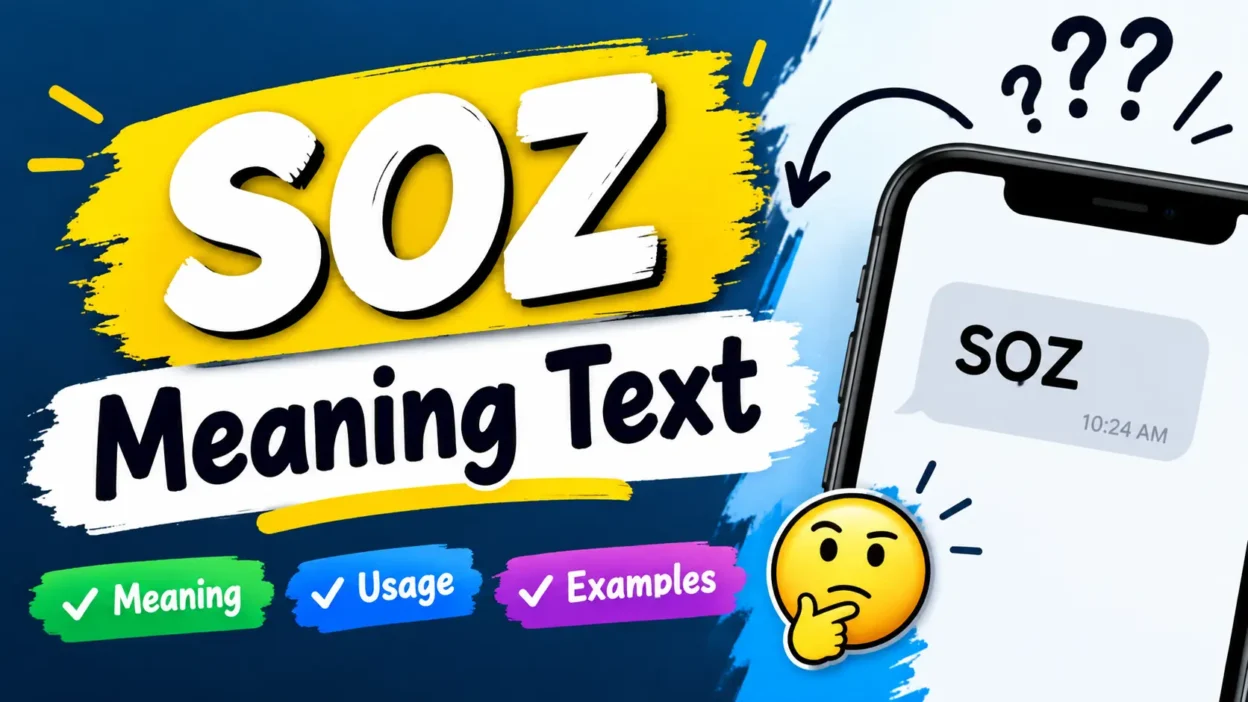
Have you ever received a message that simply says “SOZ” and wondered what the person actually meant?
If so, you’re not alone. Short texting abbreviations can sometimes be confusing, especially when they appear in casual conversations, social media comments, or private chats.
The good news is that SOZ meaning text is usually pretty simple once you understand the context. In texting and online conversations, SOZ commonly means “sorry.”
Quick Answer:
Soz means “sorry” in text messages and informal online chat. It’s British and Australian slang (also common on the internet) used for casual apologies about small things.
What Does “Soz Meaning Text” Mean?
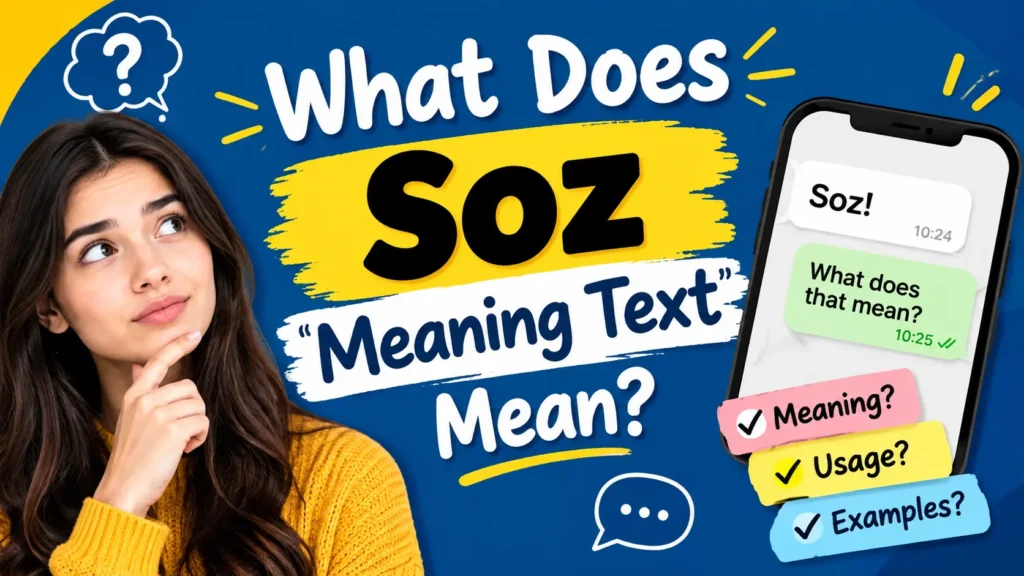
In the simplest words, soz is slang for sorry.
When someone writes “soz” in a text, they are saying they feel a bit sorry about something — usually something minor. It’s not a formal or deep apology. Think of it as a friendly, low-key way to admit a small mistake or inconvenience.
The literal meaning comes from shortening “sorry.” People turned the word into “soz” the same way they turn names like Barry into Baz or Sharon into Shaz. The “r” sound softens or drops, and a “z” sound appears at the end.
The most common meaning in texting is simply: “Sorry about that” or “I’m sorry.”
It’s mainly used in informal settings. You almost never see it in professional emails or serious conversations.
Meaning in Different Contexts

The core meaning stays the same — sorry — but the tone and strength change with the situation.
Everyday Conversation
People sometimes say “soz” out loud among friends, especially younger speakers in the UK or Australia. It sounds casual and light.
Example: “Soz, I didn’t mean to interrupt.”
Text Messages
This is where “soz” shines. It’s short, quick to type, and perfect for phones.
People use it when they’re a little late, forgot something small, or made a tiny mistake.
Social Media
On platforms like Twitter/X, Facebook comments, or group chats, “soz” appears in light replies. It keeps the mood friendly without sounding too formal.
Very common in WhatsApp groups and private chats among friends and family (especially British or Aussie users). It’s a quick way to say sorry without typing the full word.
Snapchat
On Snapchat, people use “soz” in snaps or chat replies for small things like missing a streak or sending the wrong photo. The short form fits the fast, casual style of the app.
You’ll see “soz” in comments or DMs: “Soz for the late reply!” or “Soz I missed your story.”
TikTok
In TikTok comments or captions, creators and viewers use “soz” for light apologies — “Soz if this is late” or “Soz for the spam.”
Gaming
Gamers sometimes type “soz” in chat after accidental team kills or mistakes. It’s quick and keeps the game flowing without a long apology.
Professional Communication
Almost never appropriate. In work emails, client messages, or formal settings, use the full word “sorry” instead. “Soz” can sound too casual or even rude if the situation is serious.
Internet Slang
“Soz” belongs to the wider family of internet abbreviations. It sits alongside words like “sry,” “my bad,” and “mb.” Because it’s short and easy, it spread beyond the UK and Australia into general online English.
Examples of “Soz” in Real Life

Here are five clear, everyday examples:
- Sentence: “Soz I couldn’t make it to your party last night.” Meaning: I’m sorry I missed your party. Situation: Friend text after missing a casual gathering.
- Sentence: “Soz for the late reply — was busy at work.” Meaning: Sorry I answered late. Situation: Everyday texting when someone takes hours to respond.
- Sentence: “Oops, soz, that was meant for someone else.” Meaning: Sorry, I sent that message to the wrong person. Situation: Accidental message in a group chat or DM.
- Sentence: “Soz about the mess in the kitchen.” Meaning: Sorry for leaving the kitchen messy. Situation: Roommate or family message after cooking.
- Sentence: “Soz if this is random, but can I borrow your charger?” Meaning: Sorry for asking out of the blue. Situation: Casual request between friends.
These examples show how “soz” keeps things light and friendly.
When Do People Use “Soz”?
People use “soz” in casual, low-stakes situations.
Common situations include:
- Being a few minutes late
- Forgetting a small thing
- Sending a wrong message
- Missing a casual plan
- Making a tiny mistake that doesn’t hurt anyone seriously
Who uses it?
Mostly younger people, teens, and adults in the UK, Australia, and online communities. Non-British speakers who chat a lot online also pick it up because it’s short and clear.
Why do people use it?
It’s faster to type than “sorry.” It feels friendly and less formal. In text culture, short words feel more natural and less “heavy.”
Appropriate vs inappropriate:
- Appropriate: friends, casual chats, social media, gaming.
- Inappropriate: serious apologies (break-ups, big mistakes, work problems), talking to bosses, teachers, or strangers in formal settings. In those cases, “sorry” or a fuller apology works better.
Using “soz” for something serious can make the apology feel weak or insincere.
Different Meanings of “Soz”
In English texting and slang, “soz” has essentially one main meaning: sorry.
There are no strong alternate meanings in everyday English text use.
(Note: In some other languages or older contexts the letters “soz” can mean different things, but when people search “soz meaning text,” they almost always mean the slang apology.)
The tone can shift slightly:
- Light and playful: “Soz lol”
- Mildly genuine: “Soz, I really forgot”
- Slightly sarcastic (rare): “Yeah soz” when someone doesn’t actually feel very sorry
Context always tells you which tone is intended.
Origin of “Soz”
“Soz” comes from the word “sorry.” Linguists describe it as a form of rhotacism or playful shortening where the “r” sound changes and a “z” is added, similar to how people turn Barry into Baz, Sharon into Shaz, or Warwick into Waz.
It has been documented in British English since at least 1987. A language book from that year listed “soz” as a new informal version of “sorry.” By the 1990s it appeared in newspapers, TV shows (such as The League of Gentlemen), and early internet forums.
It became especially popular with texting and social media because short words save time and fit the casual style of online chat. Australian English also adopted and used it widely. Over time it spread through the internet and is now recognized by many English speakers worldwide, even if they don’t use it themselves.
There is no single “inventor.” It grew naturally from everyday British and Australian spoken and written language.
Similar Words and Alternatives
Here are common alternatives and how they differ:
- Sorry — The full, standard word. More formal and stronger.
- Sry / Srry — Very common text abbreviation. Neutral and widely used.
- My bad — American-leaning slang. Admits fault in a casual way.
- MB — Short for “my bad.”
- Apologies — More formal and polite.
- Oops / Whoops — Focuses more on the accident than the apology.
- My fault — Clear admission of responsibility.
- SBT (sorry ’bout that) — Another short form, less common than soz.
“Soz” feels more British/Australian and slightly softer or cuter than “sry.” “My bad” feels more American. Choose based on your audience and how serious the situation is.
Common Mistakes
Mistake 1: Using “soz” for serious situations.
Saying “soz” after hurting someone’s feelings deeply can seem dismissive. Use a full “I’m really sorry” instead.
Mistake 2: Thinking it has a different meaning.
Some people guess it means something else because the letters are unusual. In texting it almost always means sorry.
Mistake 3: Overusing it.
If every message ends with “soz,” it loses meaning. Save it for real (even small) apologies.
Mistake 4: Using it in professional writing.
Work emails, school assignments, and formal messages need proper spelling and tone.
Tip to avoid confusion:
Look at the rest of the message and the relationship. If the chat is casual and the mistake is small, “soz” is fine. When in doubt, write “sorry.”
Frequently Asked Questions
1. What does soz mean in a text message?
It means “sorry.” It’s a casual British and Australian slang version used for light apologies.
2. Is soz the same as sry?
Yes, both mean sorry. “Soz” is more strongly linked to UK/Australian slang, while “sry” is more universal.
3. Is soz rude?
Not usually. In casual chats it’s friendly. It can feel rude only if used for something serious where a stronger apology is needed.
4. Do Americans use soz?
Less often than British or Australian speakers, but internet users anywhere may use or understand it.
5. Can I say soz out loud?
Yes. Many people, especially younger ones in the UK and Australia, say it in everyday speech among friends.
6. Is soz only for texting?
No. It started in spoken and written slang and became popular in texting, but people still use it in casual conversation and social media.
7. What’s the best way to reply to “soz”?
A simple “No worries,” “It’s fine,” “All good,” or “Don’t worry about it” works well for small things.
Conclusion
“Soz” is a short, friendly slang word that means “sorry” in text messages and informal online talk.
It comes from British and Australian English, has been around since at least the late 1980s, and spread widely through texting and the internet. People use it for small mistakes and light situations because it’s quick and casua

Ethan Carter is a passionate writer who creates simple, informative, and engaging content. He focuses on language, grammar, word meanings, and everyday expressions to help readers understand things clearly.